
Cups. Tablespoons. Teaspoons. We’re used to seeing these measurements in recipes, but more and more recipes, including mine, also list ingredients by weight. Don’t skip past those grams! A digital kitchen scale is one of the simplest tools for getting more consistent results, especially when you bake.

As a culinary scientist, I measure everything for consistent results, and a scale is the easiest way to do that at home. The way you scoop a cup of flour might be different from how I scoop mine, but 100 grams is 100 grams every time. Here’s why measuring by weight works, when to reach for a scale instead of measuring cups, and how to use and choose one. For the full rundown on cups and spoons, see my guide to measuring ingredients.
Jump To a Section
Kitchen Scale at a Glance
| Factor | Details |
|---|---|
| What it is | A small electronic scale that weighs ingredients in grams, ounces, and other units |
| Best for | Baking, bread, and any recipe that lists ingredients by weight |
| Why it works | Weight doesn’t change with how loosely or tightly an ingredient is packed, so you get the same amount every time |
| Key feature | The tare (zero) button, which subtracts the weight of your bowl |
| Watch out for | Tiny amounts like ⅛ teaspoon of baking powder; most scales round, so use measuring spoons |
| Care | Wipe with a damp cloth; keep liquids off the display and base unless it’s waterproof |
Why Measure by Weight?
Simple: it’s more accurate. Measuring cups measure volume, and the amount that fits in a cup depends on how the ingredient fills the space. Flour aerates easily or compacts with pressure, and brown sugar can be packed more firmly by one person than another. A scale measures the actual amount of the ingredient, no matter how it’s packed.

How Much Can a Cup of Flour Vary?
To see how much the measuring method matters, I measured 1 cup of all-purpose flour over and over until I’d used up an entire 2-pound bag:
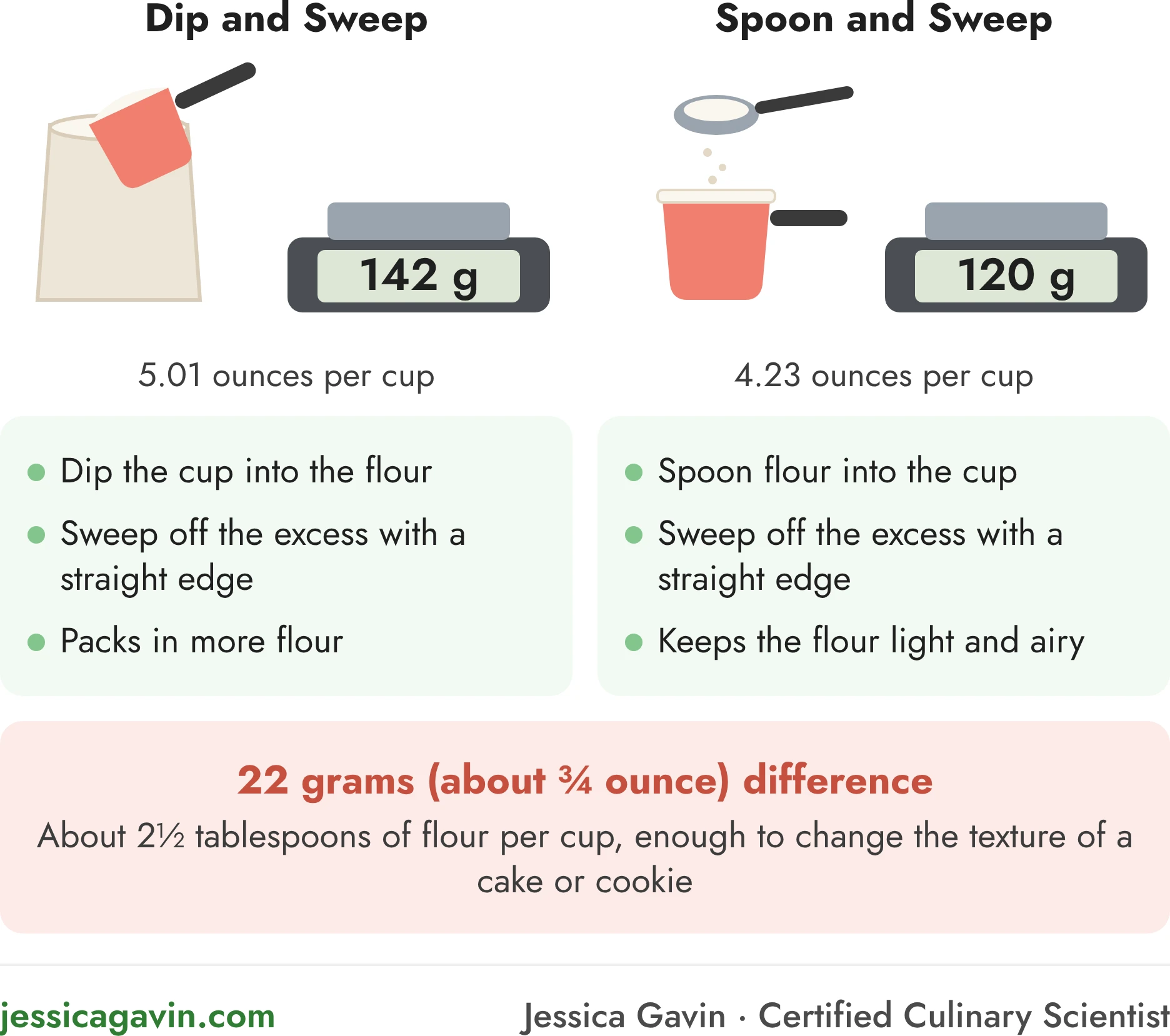
- Dip and sweep: 142 grams (5.01 ounces) per cup.
- Spoon and sweep: 120 grams (4.23 ounces) per cup.
That 22-gram (about ¾ ounce) difference is about 2½ tablespoons of flour per cup, which can noticeably change the texture of a cake or cookie. Weighing takes that guesswork away. In my recipes, I use the dip-and-sweep weight of 142 grams for 1 cup of all-purpose flour.
More Reasons to Use a Scale
- Consistent results: Baking is all about chemistry, and the right ratio of ingredients is what makes a recipe rise, brown, and set the way it should. Weighing helps you make a recipe exactly as it was written.
- Fewer dishes: Set one bowl on the scale and add ingredients one after another, with no stack of measuring cups in the sink.
- Easy to scale recipes up or down: You’re not limited by the sizes of your measuring cups. Just multiply the grams.
- Odd amounts: It’s handy for recipes that call for part of a can or package, or for weighing coffee beans for your morning cup.
When to Use a Scale vs. Measuring Cups
In my recipes, you’ll usually see cup, gram, and ounce measurements, whether the recipe is sweet or savory. Cups work fine for most savory cooking, but a scale is worth it when precision matters. I often use both, verifying the weight on a scale after measuring by volume.
- Use a scale for: Flour, sugar (especially brown sugar), cocoa powder, chocolate, and anything in a recipe that lists grams. It’s especially helpful for baking and bread.
- Use measuring spoons for: Small amounts like baking powder, baking soda, salt, and spices. Most kitchen scales round to the nearest gram, so they can’t tell the difference between ⅛ teaspoon of baking powder (about 0.5 grams) and twice that much.
- Either works for: Liquids like milk and water. A liquid measuring cup read at eye level is accurate, and a scale works too.
Here’s a quick look at when I reach for a scale and when cups are just fine:

Cups to Grams Chart for Baking
These are the weights I use for common baking ingredients in my recipes. Keep this chart handy when a recipe only lists cups and you want to weigh instead.
| Ingredient | 1 cup | ½ cup | ¼ cup |
|---|---|---|---|
| All-purpose flour | 142 g | 71 g | 36 g |
| Granulated sugar | 198 g | 99 g | 50 g |
| Brown sugar, packed | 198 g | 99 g | 50 g |
| Powdered sugar | 113 g | 57 g | 28 g |
| Butter | 227 g | 113 g (1 stick) | 57 g |
Need to convert a recipe? See my kitchen conversion chart.
How to Use a Kitchen Scale
- Set the scale on a flat, stable surface and turn it on.
- Choose your unit, such as grams or ounces, to match the recipe.
- Place an empty bowl or container on the scale.
- Press the tare (or zero) button so the display reads 0. This subtracts the weight of the bowl.
- Add your ingredient until you reach the weight in the recipe.
- Press tare again before adding the next ingredient to the same bowl.

Watch how quick it is:

Recipes to Try with Your Scale
My baking recipes list grams alongside cups, so they’re a great place to start. Try my soft sugar cookies, pound cake, or Hawaiian rolls.
How to Choose a Kitchen Scale
- Go digital: Digital scales are more accurate and easier to read than analog scales.
- Tare button: This is a must. It lets you zero out the weight of your bowl and add several ingredients to one bowl.
- Unit button: Look for one that switches between grams and ounces with the press of a button.
- Easy-to-read display: A large screen helps, and a pull-out display keeps a big bowl or plate from covering the numbers.
- Capacity: Scales range from about 5 pounds up to 30 pounds. A higher capacity is helpful if you bake large batches of bread dough.
- Easy to clean: A flat, smooth top wipes clean easily. Some scales are waterproof.
I use an OXO kitchen scale (affiliate link). Its pull-out display keeps the numbers visible even when a large plate or bowl sits on top. Find all of my favorite kitchen tools on my Shop page.

Care and Cleaning
- Wipe it clean: Use a damp cloth after each use. Don’t submerge it in water.
- Keep liquids away: Unless your scale is waterproof, be careful not to spill liquids on or near it.
- Handle it gently: Don’t drop, shake, or overload it, which can throw off its accuracy.
- Replace the batteries: If the readings start to jump around or the display dims, it’s time for new batteries.
Recipes to Make with a Kitchen Scale


Frequently Asked Questions
Yes, especially if you bake. A scale gives you the same amount of an ingredient every time, no matter how it’s scooped or packed, so your results are more consistent. It also means fewer measuring cups to wash.
By weight. When I measure flour, the dip-and-sweep method gives 142 grams per cup and the spoon-and-sweep method gives about 120 grams, a difference of about 2½ tablespoons. A scale removes that variation.
Tare sets the scale back to zero with a bowl or container on it, so only the weight of the ingredient is measured. Press it again before adding each new ingredient to the same bowl.
Yes. Place your container on the scale, tare it, and pour in the liquid. Many digital scales can also switch to fluid ounces or milliliters.
Use measuring spoons instead. Most kitchen scales round to the nearest gram, so they can’t accurately measure tiny amounts like ⅛ teaspoon of baking powder, which weighs about half a gram.
Wipe it with a damp cloth after each use. Don’t submerge it, and keep liquids away from the display and base unless the scale is waterproof.
Once you start weighing your ingredients, you’ll wonder how you ever baked without a scale!


Leave a Comment