
The reverse sear steak method might change the way you cook beef forever. This two-step process involves baking in the oven and searing in a hot pan. It’s a reader favorite, with hundreds of rave reviews!

Jessica’s Recipe Science
- The oven’s gentle, consistent heat provides more control of internal temperature and prevents overcooking.
- Cooking in the oven below 300 degrees activates enzymes that tenderize the meat.
- Pan-searing at the end of cooking develops a golden-brown crust through the Maillard Reaction.
Featured Comment 202
“I have used this recipe three times now, and it is THE best way to cook a steak! Thanks for a great recipe”—Katt
Why It Works
In culinary school, I was taught to sear filet mignon or ribeye in a hot pan to lock in the juices. After numerous tests, I’ve found that browning adds a flavorful crust, but the juiciness varies. A thick steak takes more time, often yielding an overcooked, dry exterior with only a small pink center.
America’s Test Kitchen introduced me to the reverse sear method, and it’s been my go-to technique ever since. With reverse sear, you cook the meat gently first in the oven and then sear it on the stovetop.
- You don’t need to bring the steak to room temperature for even cooking; the oven does the job quickly.
- The warm oven dries the surface moisture for effective pan-searing later on.
- More consistent pink internal color while limiting cooked grey edges.
- A thick cut of beef can be gently cooked to nearly the right level of doneness.
- A quick pan-searing on the stovetop develops a stunning crust and flavor.
Jump To a Section
Ingredients You’ll Need

- Steak: This reverse sear method is best for thicker cuts, at least 1 ½ to 2 inches thick. Anything below 1 inch will cook too quickly. Choose a quick-cooking, high-quality steak (USDA prime or choice) with some marbling. My top choices are ribeye, top sirloin, New York strip, porterhouse, T-bone, and filet mignon.
- Oil: Use a high smoke point oil like avocado oil, light olive oil, soybean, or vegetable oil to sear the steaks. Even better, use clarified butter for the richest taste.
- Butter: When the steak is nearly done cooking, I baste it with butter. The milk solids brown, adding toasted aromas and flavor to the meat.
- Seasonings: Salt and black pepper enhance the beefy taste. This technique really enhances the surface flavor and tender texture.
See the recipe card below for all ingredients and measurements (US and metric).
Temperature and Timing
| Doneness | Bake Until | Sear Until | Serve At |
| Rare | 85-90ºF (29-32ºC) | 115-120°F (46-49ºC) | 120-125ºF (49-52ºC) |
| Medium-Rare | 90-95ºF (32-35ºC) | 120-125°F (49-52ºC) | 125-130ºF (52-54ºC) |
| Medium | 100-105ºF (38-41ºC) | 130-135°F (54-57ºC) | 135-140ºF (57-60ºC) |
| Medium-Well | 110-115ºF (43-46ºC) | 140-145°F (60-63ºC) | 145-150ºF (63-66ºC) |
| Well-Done | 120-125ºF (49-52ºC) | 155°F (68ºC) | 160ºF (71ºC) |
How to Reverse Sear Steak
Step 1: Heat the Oven
Set the oven rack in the center position for even heat distribution. Heat the oven to 275°F (135ºC). Line a rimmed baking sheet with foil or parchment paper, then place a wire rack on top.

Step 2: Prepare the Steaks
Pat the steaks dry with paper towels to remove excess moisture.
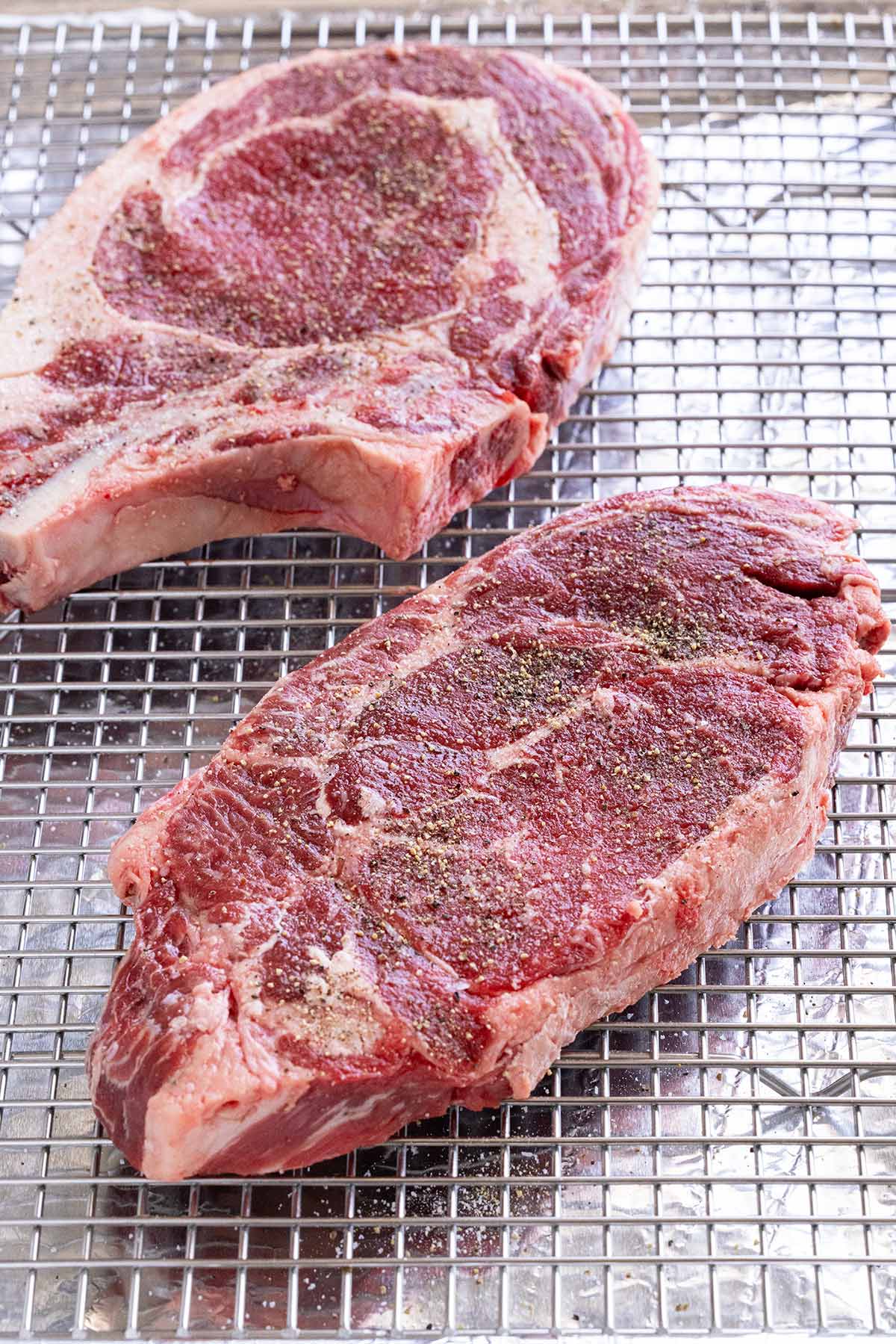
Place the steaks on the wire rack and season both sides with salt and pepper.
Pro Tip: Refrigerate the meat uncovered for 2 to 24 hours before cooking for a drier surface and a better-seasoned steak.

Step 3: Cook the Steak in the Oven
Transfer the steaks to the preheated oven. Bake until they reach the “Bake Until” temperature in the chart above, about 35 degrees below the final serving temperature. This usually takes 15 to 25 minutes, but thicker steaks, steaks straight from the fridge, or an oven that runs cool can take longer. Go by temperature, not time.
Tips for Perfect Execution: Use an instant-read meat thermometer to check the internal temperature of the thickest part of the steak.

Step 4: Pan Sear the Steak
Heat a large cast iron skillet or stainless steel pan over high heat. Once hot, add the oil and sear each side for about 1 to 2 minutes. Cook the sides to render the fat, about 30 to 60 seconds per side.
Minimize Smoke: Searing over high heat creates some smoke, so turn on your range hood or open a window before you start. Pat the steaks dry and use a high smoke point oil, like avocado oil, so the crust forms quickly.
Step 5: Baste with Butter
Reduce the heat to medium-low and add the butter. Spoon the melted butter over the steaks to baste for about 1 minute to enhance browning and flavor.
Experimentation Encouraged: Add aromatics like sliced garlic cloves, shallots, fresh rosemary, or thyme sprigs. Toss them in at the end when basting with the butter.

Step 6: Rest, then Serve
Transfer the seared steak to a clean plate or back to the wire rack set on a baking sheet. Rest briefly for 5 to 10 minutes to allow carryover cooking to finish heating the steaks. As I plate the sides, I find the steak is at the perfect serving temperature.
Frequently Asked Questions
It’s simple! Cook the steaks in a moderately warm oven at 275°F (135ºC). Sear in a hot skillet with oil on the stovetop until golden brown on the surface.
This method works best for thick-cut steaks, 1 ½ inches or more. It’s great for tender filet mignon, New York strip steak, porterhouse, ribeye, T-bone, or large tomahawk steaks. This method also works well for grilling tri-tip.
Cooking the steak in the oven at 275 degrees activates natural cathepsin enzymes that tenderize the meat and help break down muscle proteins. Gradual heating increases enzyme activity, making the meat more tender over time. Activity drops at about 122°F (50°C), but 15 to 25 minutes of slow heating lets the enzymes do their work.
For a tasty smoked flavor, reverse sear on the grill. Create an indirect heating side of the grill. Once warm, cover and cook the steaks on the cooler side until they reach the “Bake Until” temperature for your desired doneness in the chart above. Remove the steaks, then cover and increase the grill temperature to high, or transfer to the direct-heat side if using a charcoal grill. Sear until char marks form, about 30 to 60 seconds per side.
Sous vide steak has the most consistent doneness because it’s hard to overcook. It takes much longer and is harder to sear without drying out because it’s cooked in its own juices. Reverse-seared steaks quickly develop golden, flavorful crusts after the initial oven cooking. It’s a quicker, more affordable process without a fancy immersion circulator, bags, or vacuum sealers.
More Steak Recipes


If you tried this Reverse Sear Steak method, please leave a 🌟 star rating and let me know how it went in the 📝 comments below!
Reverse Sear Steak

Ingredients
- 2 steaks, 1 ½ to 2" thick, like ribeye or filet mignon
- kosher salt, for seasoning
- black pepper, for seasoning
- 1 tablespoon vegetable oil
- 1 tablespoon unsalted butter, optional
Instructions
- Heat the Oven – Set the oven rack in the center position. Heat to 275°F (135ºC). Line a rimmed baking sheet with foil or parchment paper, and then place a wire rack on top.
- Prepare the Steaks – Dry the steaks with a paper towel to remove excess surface moisture. Transfer to the wire rack. Generously season both sides with salt and black pepper.
- Cook in the Oven – Transfer the steaks to the oven and cook until the internal temperature on a meat thermometer reaches: 85 to 90ºF (29 to 32ºC) for rare, 90 to 95ºF (32 to 35ºC) for medium-rare, 100 to 105ºF (38 to 41ºC) for medium, 110 to 115ºF (43 to 46ºC) for medium-well, and 120 to 125ºF (49 to 52ºC) for well done. This usually takes 15 to 25 minutes, but thicker steaks or an oven that runs cool can take longer, so go by temperature, not time. Start checking after 15 minutes. Remove the steaks from the oven and set aside.
- Pan Sear – Heat a large 12-inch cast iron skillet or stainless steel pan over high heat. Wait a few minutes, then add the oil. Once hot and just beginning to smoke, carefully add the steaks to the pan. Sear the first side until a deep brown crust is formed, about 1 to 2 minutes. Flip and sear the other side for about 1 to 2 minutes. Use tongs to turn the steaks on their sides to cook and render the remaining fat, about 30 to 60 seconds per side.Cook until the internal temperature reaches: 115 to 120°F (46 to 49ºC) for rare, 120 to 125°F (49 to 52ºC) for medium-rare, 130 to 135°F (54 to 57ºC) for medium, 140 to 145°F (60 to 63ºC) for medium-well, and 155°F (68ºC) for well done. Adjust the heat and cook time as needed to reach desired doneness.
- Baste with Butter – Reduce the heat to medium-low and add the butter to the pan. Once melted, use a spoon to briefly baste the tops of the steaks for one minute.
- Rest and Serve – Transfer the steaks to a clean plate or cutting board. Rest at room temperature for 5 to 10 minutes before serving.
Recipe Video

Notes
- Steak Selection: I recommend ribeye, New York strip, filet mignon, porterhouse, T-bone, or top-sirloin. The reverse sear method works best for thick cuts 1 ½ inches thick or more.
- Cooking Thinner Steaks: This method can be used for at least 1-inch thick steaks. Check them after 10 minutes of cooking in the oven and then every few minutes after.
- Oil Options: Use a high smoke point oil, such as vegetable, avocado, or light olive oil. Clarified butter also works well.
- Minimizing Smoke: Turn on your range hood or open a window before searing. Pat the steaks dry so the crust forms quickly.
- Checking the Steaks in the Oven: Take the steaks’ temperature at 15 minutes, testing about every 5 minutes until the target doneness is reached. Open and close the door quickly to minimize heat loss, as this will extend cook time. A probe thermometer works well for monitoring.
- Make it Dairy-Free: Omit the butter or use a plant-based butter substitute like margarine.
- Make it Paleo: Use ghee instead of vegetable oil and butter.
Nutrition Facts
Percent Daily Values are based on a 2000-calorie diet. All nutritional information is based on estimated third-party calculations. Each recipe and nutritional value will vary depending on the brands you use, measuring methods, and portion sizes per household.


Amanda says
275 for 20 mins my steak was still like 80 degrees. I needed to cook much longer.
Jessica Gavin says
I’m sorry it took longer than expected, Amanda! Oven time can vary quite a bit depending on the steak’s thickness, how cold it is going in, and how accurate your oven runs, so the thermometer is the best guide. Keep baking until it reaches the “Bake Until” temperature in the chart, checking every 5 minutes after the first 15. I hope you’ll give it another try!
Edward says
Really good but smoked out my house on high within 2min!!!!!! I’ll try 7.5 heat vs 9 next time! Cheers!
Jessica Gavin says
I’m happy to hear that you enjoyed the reverse sear steak recipe, Edward! You can definitely turn the heat down on the stovetop before adding the oil to prevent smoking.
Holly says
Absolute perfection! I may never grill another steak!
Jessica Gavin says
Thrilled to hear that you had success with the reverse sear steak recipe, Holly!
No Spam says
Came out great! I paired it with lemon roasted asparagus and potatoes.
Jessica Gavin says
I love the combo of the reverse seared steak with asparagus and potatoes!
Kim says
This is the best way to prepare steaks, perfect temperature control!
Jessica Gavin says
Great to hear that you had success with the reverse sear steak method, Kim!
Cate says
I tried this for a NY and Ribeye and they turned out perfectly cooked and tender. I lowered the heat after searing and added butter, fresh thyme and garlic cloves. It was amazing! It was my first try reverse searing and this will be my go to method from now on!
Jessica Gavin says
Great to hear that you had success with the reverse sear method! Love the addition of butter and herbs!
Hunter says
How do you do this without smoking up the house?
Jessica Gavin says
Great question, Hunter! Searing over high heat does create some smoke, so turn on your range hood or crack a window before you start. Pat the steaks dry, use a high smoke point oil like avocado oil, and add the oil once the pan is hot, right before the steaks go in. Since the oven does most of the cooking, the sear only takes a few minutes.