
Need to convert a recipe from cups to grams, or from Fahrenheit to Celsius? This kitchen conversion chart covers the measurements I use most: volume, weight, common baking ingredients, butter, and oven temperatures. Keep it handy as your go-to cooking conversion chart for any recipe.
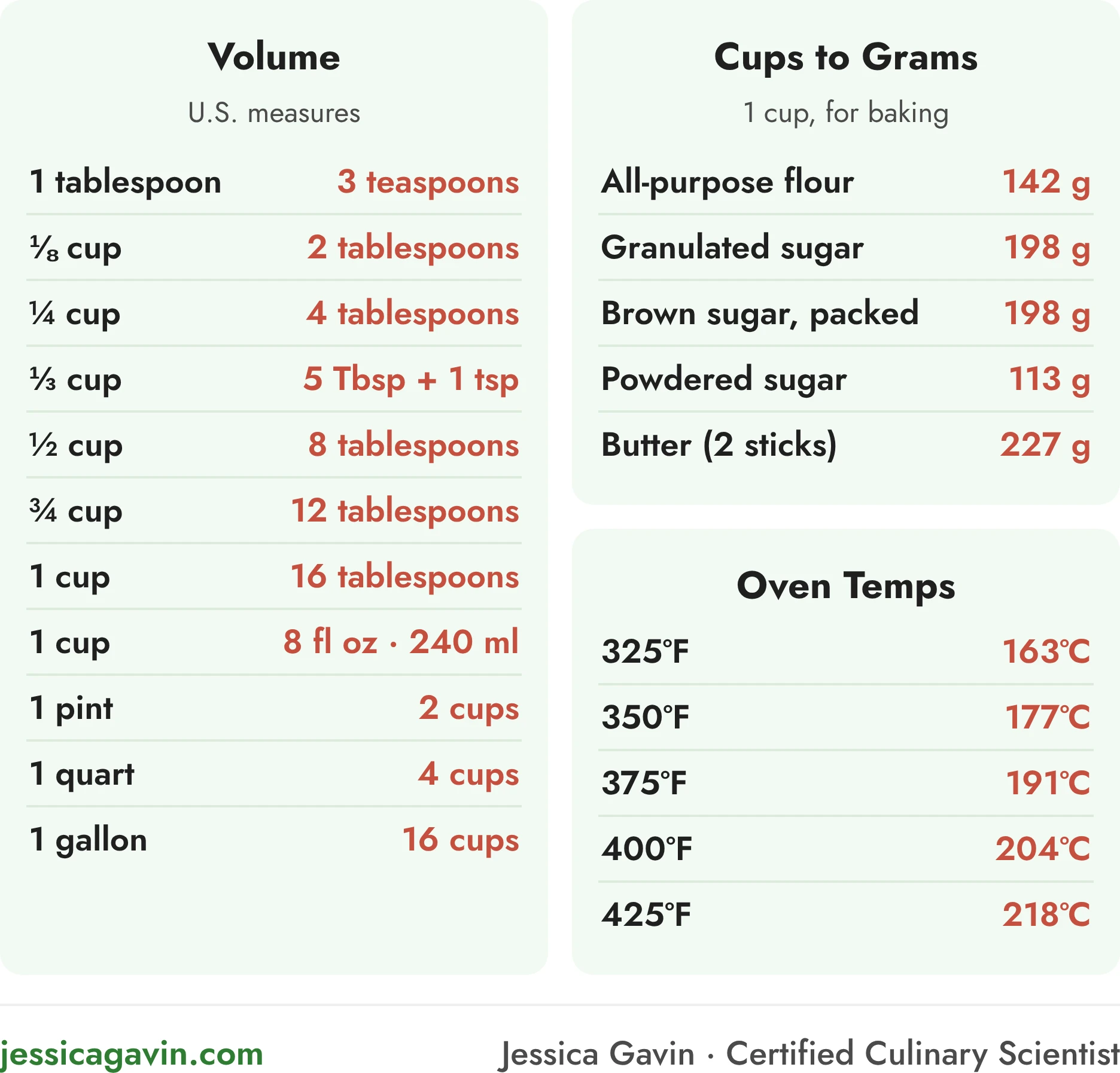
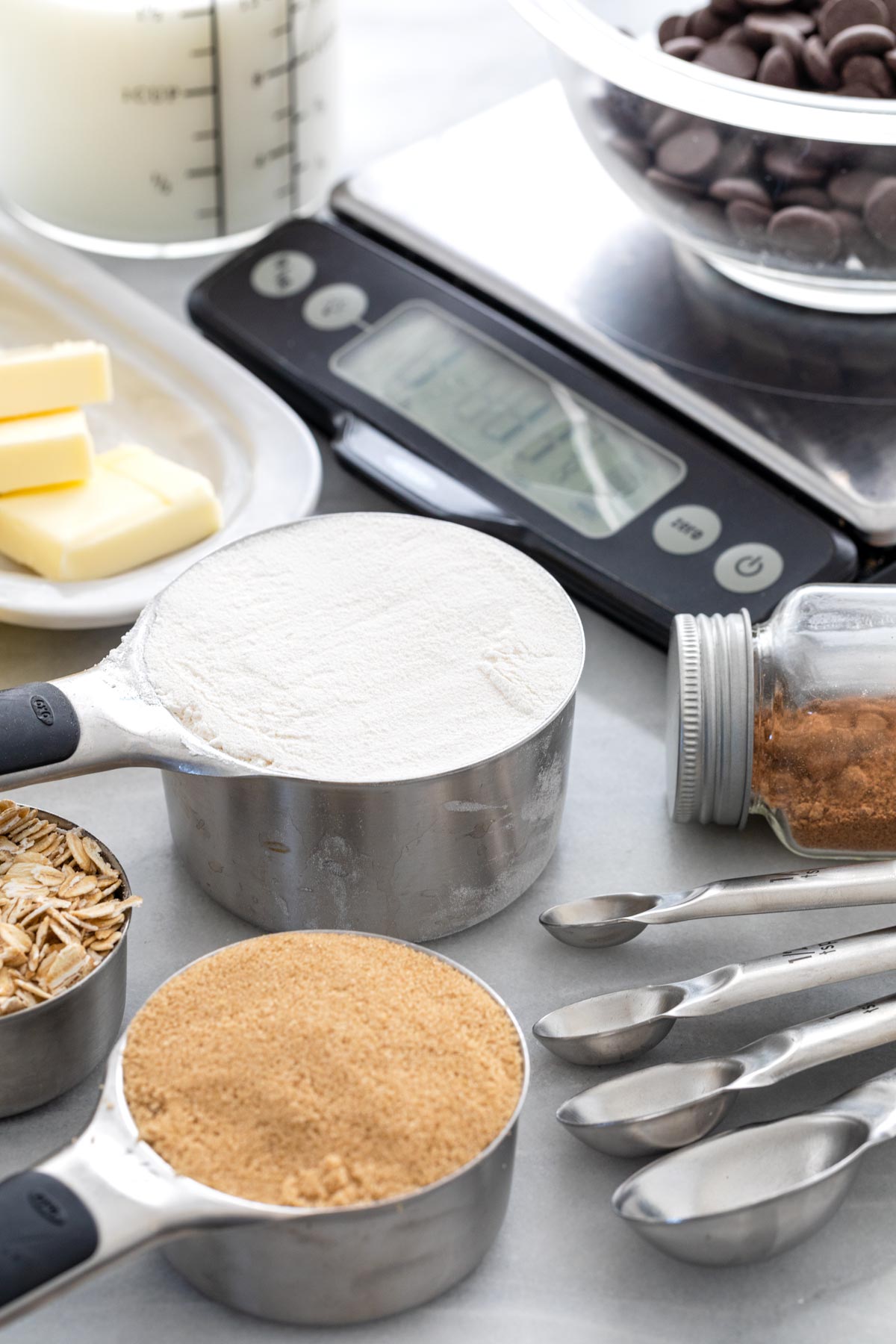
Measurements are U.S. customary. Metric equivalents are rounded to make them easy to use in the kitchen. For the most accurate results, especially when baking, weigh your ingredients on a kitchen scale. Here’s my guide on how to measure ingredients with cups and spoons.
Jump To a Section
Volume Conversions
Use this chart to convert between teaspoons, tablespoons, cups, fluid ounces, and milliliters.
| U.S. measure | Equivalent | Fluid ounces | Milliliters |
|---|---|---|---|
| ¼ teaspoon | 1.25 ml | ||
| ½ teaspoon | 2.5 ml | ||
| 1 teaspoon | 5 ml | ||
| 1 tablespoon | 3 teaspoons | ½ fl oz | 15 ml |
| ⅛ cup | 2 tablespoons | 1 fl oz | 30 ml |
| ¼ cup | 4 tablespoons | 2 fl oz | 60 ml |
| ⅓ cup | 5 tablespoons + 1 teaspoon | 2⅔ fl oz | 80 ml |
| ½ cup | 8 tablespoons | 4 fl oz | 120 ml |
| ⅔ cup | 10 tablespoons + 2 teaspoons | 5⅓ fl oz | 160 ml |
| ¾ cup | 12 tablespoons | 6 fl oz | 180 ml |
| 1 cup | 16 tablespoons | 8 fl oz | 240 ml |
| 1 pint | 2 cups | 16 fl oz | 475 ml |
| 1 quart | 4 cups (2 pints) | 32 fl oz | 950 ml |
| 1 gallon | 16 cups (4 quarts) | 128 fl oz | 3.8 liters |
Weight Conversion Chart
Use this chart to convert ounces and pounds to grams. Ounces here are weight, not fluid ounces.
| Ounces | Pounds | Grams |
|---|---|---|
| 1 oz | 28 g | |
| 2 oz | ⅛ lb | 57 g |
| 4 oz | ¼ lb | 113 g |
| 8 oz | ½ lb | 227 g |
| 12 oz | ¾ lb | 340 g |
| 16 oz | 1 lb | 454 g |
| 32 oz | 2 lb | 907 g |
| 35.3 oz | 2.2 lb | 1 kilogram (1,000 g) |
Cups to Grams for Baking
A cup of flour and a cup of sugar don’t weigh the same, so there’s no single cups-to-grams number. These are the weights I use for common baking ingredients in my recipes. Learn why weighing is more accurate in my kitchen scale guide.
| Ingredient | 1 cup | ½ cup | ¼ cup |
|---|---|---|---|
| All-purpose flour | 142 g | 71 g | 36 g |
| Granulated sugar | 198 g | 99 g | 50 g |
| Brown sugar, packed | 198 g | 99 g | 50 g |
| Powdered sugar | 113 g | 57 g | 28 g |
| Butter | 227 g | 113 g (1 stick) | 57 g |
Butter Conversions
Butter sticks in the U.S. are marked in tablespoons, which makes measuring easy.
| Sticks | Tablespoons | Cups | Ounces | Grams |
|---|---|---|---|---|
| ½ stick | 4 tablespoons | ¼ cup | 2 oz | 57 g |
| 1 stick | 8 tablespoons | ½ cup | 4 oz | 113 g |
| 2 sticks | 16 tablespoons | 1 cup | 8 oz | 227 g |
| 4 sticks | 32 tablespoons | 2 cups | 16 oz (1 lb) | 454 g |
Oven Temperature Conversions
To convert Fahrenheit to Celsius, subtract 32, multiply by 5, and divide by 9. Or use this chart for common oven temperatures. Many ovens run hotter or cooler than the dial says, so an oven thermometer is helpful, especially for baking.
| Fahrenheit | Celsius |
|---|---|
| 250ºF | 121ºC |
| 275ºF | 135ºC |
| 300ºF | 149ºC |
| 325ºF | 163ºC |
| 350ºF | 177ºC |
| 375ºF | 191ºC |
| 400ºF | 204ºC |
| 425ºF | 218ºC |
| 450ºF | 232ºC |
| 475ºF | 246ºC |
| 500ºF | 260ºC |
Looking for doneness temperatures for meat, poultry, and seafood? See my food temperature guide.
Common Abbreviations
| Abbreviation | Measurement |
|---|---|
| tsp or t | Teaspoon |
| Tbsp or T | Tablespoon |
| c | Cup |
| fl oz | Fluid ounce |
| pt | Pint |
| qt | Quart |
| gal | Gallon |
| oz | Ounce (weight) |
| lb | Pound |
| g | Gram |
| kg | Kilogram |
| ml | Milliliter |
| L | Liter |
Frequently Asked Questions
There are 16 tablespoons in 1 cup, 8 tablespoons in ½ cup, and 4 tablespoons in ¼ cup.
There are 3 teaspoons in 1 tablespoon.
There are 8 fluid ounces in 1 cup. Fluid ounces measure volume, though, not weight. A cup of all-purpose flour weighs about 5 ounces (142 grams), while a cup of granulated sugar weighs about 7 ounces (198 grams).
I use 142 grams for 1 cup of all-purpose flour in my recipes. The exact amount in a cup depends on how you measure it, which is why weighing flour gives the most consistent results.
There are 2 sticks of butter in 1 cup. One stick is ½ cup, 8 tablespoons, or 113 grams.
Subtract 32 from the Fahrenheit temperature, multiply by 5, then divide by 9. For example, 350ºF is about 177ºC.
More Kitchen Basics


Food Science
How to Measure Ingredients for Baking
Food Science
Baking Cooking Method

Food Science




Ramona Wood says
I am always on online sites. I am most impressed with your, Very educational, the photos are professional, you cover all aspects of cooking , as you say the science behind it. I have been reading for quite awhile. time has flown by. Thank you, you have worked hard on this, I can see you are passionate.
Jessica Gavin says
Thank you so much for your kind feedback, Ramona!
david says
converting grams is a problem, i dont weigh materials of food i measure if necc, is there a simple formula for converting grams to us measurements.. do you brine all meat or just the toughter ones
Jessica Gavin says
Hi David- Great question! 30g grams is about 1 ounce, which is 2 tablespoons (1/8 cup). So you can use some general US volume conversions. However, this all depends on if it is liquid or solid. The mass of solids varies so that’s why it’s tricky to measure flour accurately in a cup vs on a scale. You can brine any type of meat.
Robert Lillard says
Jessica, thanks for all the good information. With the growth of Sous Vide style cooking it would be very helpful to see for charts / graphs of temp vs. time to kill pathogens in meat. For example, once a given meat has reached 140 degrees it takes how long to pasteurize that meat? How long once the meat has reached 150 degrees? Etc.——Thanks!
Jessica Gavin says
Thank you for the suggestion Robert! I will definitely keep cooking temps for sous vide in consideration for a future post 🙂
Michelle Aragon says
SO useful – thank you!
Jessica Gavin says
No problem Michelle!