
The holidays are all about sharing a big meal with the people you love, so the last thing you want is for anyone to go home feeling sick. Cooking for a crowd means more food, more hands in the kitchen, and dishes sitting out longer than usual. Whether you’re roasting a Thanksgiving turkey, serving a Christmas prime rib, or hosting Easter brunch, these holiday food safety tips cover everything from thawing and cooking to storing the leftovers, so you can relax and enjoy the feast.

Follow the Two-Hour Rule
Bacteria grow fastest between 40ºF and 140ºF (4ºC and 60ºC), which is why the USDA calls it the danger zone. Perishable food shouldn’t sit out at room temperature for more than 2 hours, or more than 1 hour if it’s above 90ºF (32ºC), like at an outdoor gathering. After that, throw it out. On a busy holiday, it’s easy to lose track of time, so set a timer when dinner hits the table. Celebrating outdoors for the 4th of July or a summer cookout? See my barbecue and picnic food safety tips.
Keep Hot Foods Hot and Cold Foods Cold
- Hot foods: Keep them at 140ºF (60ºC) or warmer. Slow cookers, chafing dishes, and warming trays all work, but check the setting. Some warming trays only reach about 120ºF, which isn’t hot enough.
- Cold foods: Keep them at 40ºF (4ºC) or below. Set serving bowls of salads, dips, and desserts over a tray of ice, and keep a towel nearby to catch the melting water.
- Serve in batches: Put out smaller platters and refill them from the oven or fridge, rather than leaving everything out for the whole party.
Thaw the Turkey Safely
Never thaw a turkey on the counter. The outside can warm into the danger zone while the center is still frozen. The safest method is the refrigerator: leave the turkey in its wrapping, set it on a rimmed pan on the bottom shelf to catch any juices, and allow about 24 hours for every 4 pounds. Short on time? Thaw it in cold water, changing the water every 30 minutes, and cook it as soon as it’s thawed. Here’s my full guide on how to thaw a turkey, including when to start thawing for Thanksgiving.
Prevent Cross-Contamination
- Wash your hands often: Use soap and warm water before cooking, after handling raw meat, and after any break.
- Don’t rinse the turkey: Washing raw poultry doesn’t remove bacteria, and it can splash them onto the sink and counters. Cooking it to a safe temperature is what makes it safe.
- Use separate cutting boards: Keep one for raw meat and another for produce and cooked foods, and use separate plates and utensils for raw and cooked items.
- Clean as you go: Wash cutting boards, knives, and utensils in hot, soapy water, and wipe down counters, sinks, and stovetops after they touch raw meat.
Cook to a Safe Temperature

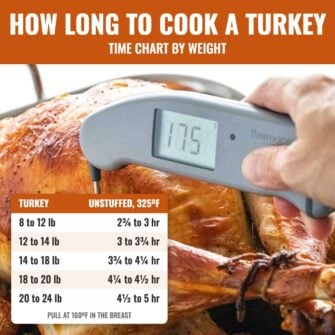
A meat thermometer is the only reliable way to know your turkey is done. The USDA considers turkey safe at 165ºF (74ºC), measured in the thickest part of the breast and the innermost part of the thigh and wing. In my roast turkey and roast turkey breast recipes, I pull the breast at about 160ºF (71ºC), because carryover cooking brings it up to 165ºF as the turkey rests.
For the safest results, bake your stuffing in a separate dish instead of inside the bird, and make sure it reaches 165ºF (74ºC) too. Remove the giblets after thawing and cook them separately, or use them for homemade gravy.
Safe Temperatures for Holiday Mains
Here are the USDA’s minimum safe internal temperatures for the dishes that show up on most holiday tables. Check the thickest part of the meat, away from any bone.
| Food | USDA Minimum Safe Temperature |
|---|---|
| Turkey, chicken, and other poultry | 165ºF (74ºC) |
| Stuffing and casseroles | 165ºF (74ºC) |
| Beef and lamb roasts (like prime rib) | 145ºF (63ºC), then rest 3 minutes |
| Fresh (uncooked) ham and pork roasts | 145ºF (63ºC), then rest 3 minutes |
| Fully cooked ham, reheated | 140ºF (60ºC) |
| Egg dishes, like breakfast casseroles and quiche | 160ºF (71ºC) |
| Leftovers, reheated | 165ºF (74ºC) |
Many cooks prefer beef roasts cooked less than 145ºF. For my recommended doneness temperatures, see my prime rib recipe. For Easter or Christmas ham, try my honey glazed ham.
Holiday Eggs and Egg Dishes
Hard-cooked eggs follow the same 2-hour rule as other perishable foods, including dyed Easter eggs and deviled eggs. Keep them in the refrigerator until you’re ready to hide or serve them, and toss any that have been out longer than 2 hours. Refrigerated hard-cooked eggs are best eaten within a week.
How to Store Holiday Leftovers
- Refrigerate within 2 hours: Get leftovers into the fridge or freezer within 2 hours of serving.
- Use shallow containers: Divide large amounts into smaller, shallow containers so they cool quickly. Carve the turkey off the bone before storing it, and store the stuffing separately.
- Don’t overpack the fridge: Cold air needs room to circulate so everything chills down quickly.
- Eat or freeze within 3 to 4 days: Refrigerated leftovers keep for 3 to 4 days. For longer storage, freeze them. Frozen turkey leftovers are best used within 2 to 6 months.
- Reheat to 165ºF (74ºC): Reheat leftovers until they’re steaming hot all the way through, and bring gravy to a rolling boil.
Need ideas? Turn extra turkey into turkey noodle soup, turkey pot pie, or turkey tetrazzini.
Frequently Asked Questions
No more than 2 hours at room temperature, or 1 hour if it’s above 90ºF (32ºC). After that, bacteria can multiply to unsafe levels, so throw the food out.
Leftover turkey, ham, roasts, stuffing, and side dishes keep for 3 to 4 days in the refrigerator. Freeze them for longer storage, and reheat leftovers to 165ºF (74ºC) before eating.
No. Rinsing raw turkey doesn’t make it safer, and it can spread bacteria around your sink and kitchen. Cooking the turkey to 165ºF (74ºC) is what kills harmful bacteria.
It’s safest to bake stuffing in a separate dish. If you do stuff the turkey, the stuffing in the center must reach 165ºF (74ºC), which can take long enough that the turkey meat overcooks.
With these tips, you can focus on the fun part: the food and the company. Find more inspiration in my Thanksgiving recipes, Christmas recipes, and Easter recipes.




Leave a Comment