
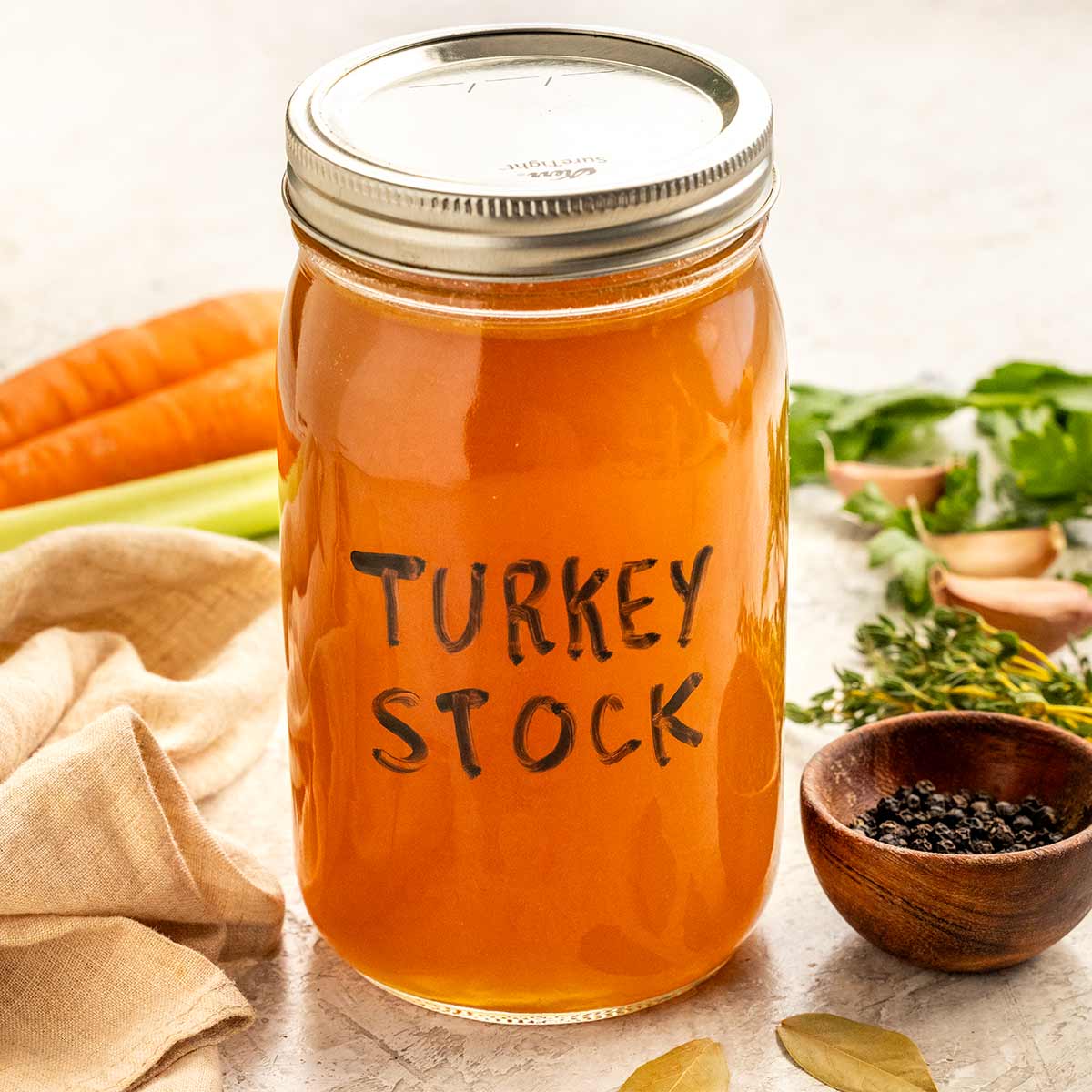
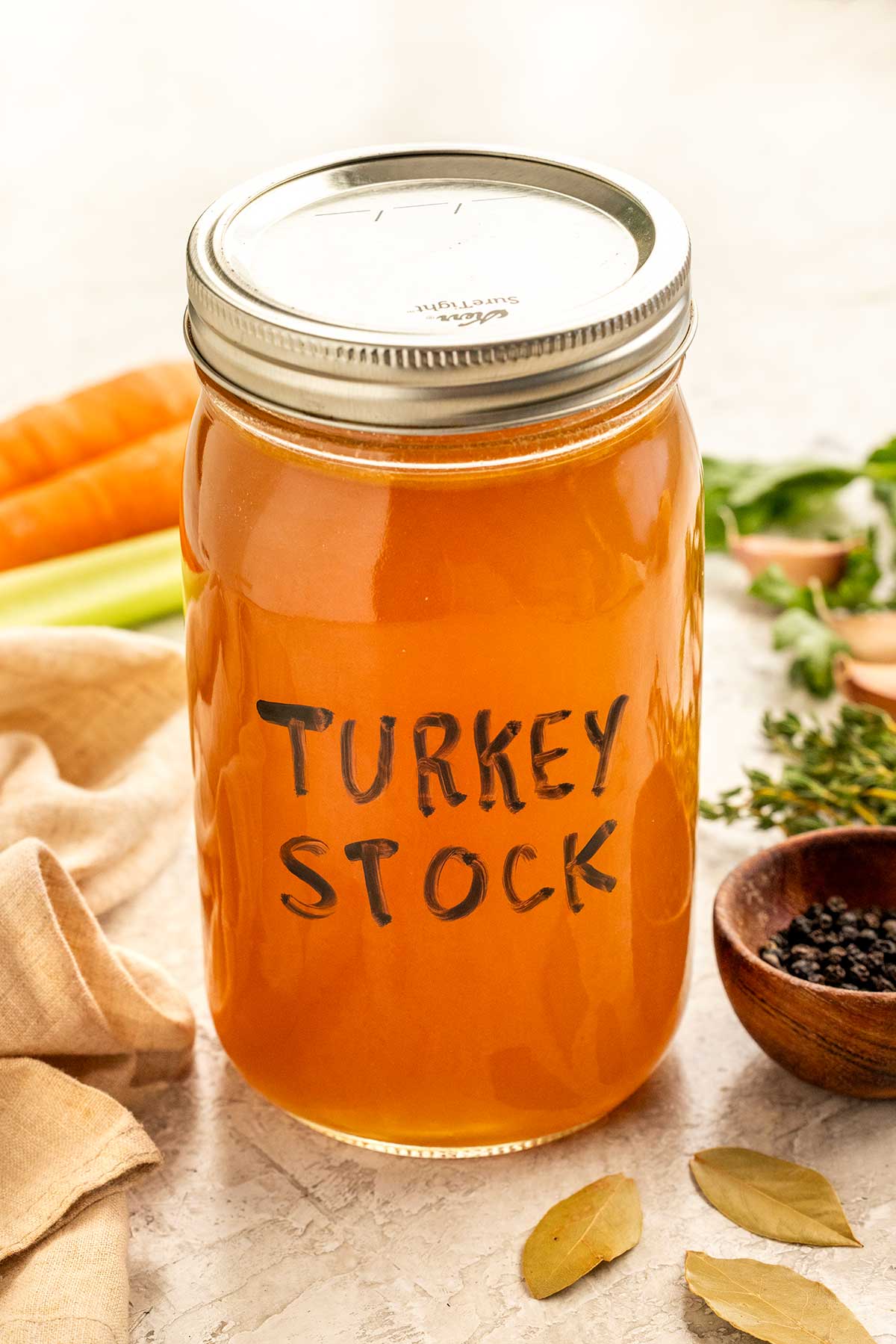
Roasting is the secret to turning leftover turkey bones into a deeply savory, golden turkey stock recipe. With this quick extra step, you’ll build incredible flavor that elevates everything from soups and sauces to gravies.
This method makes a rich brown stock. If you want a more neutral-tasting white stock, check out my methods for chicken stock or chicken broth.
Jessica’s Recipe Science
- Roasting the turkey bones jumpstarts the Maillard reaction, creating caramelized flavors and a deep golden color in the stock.
- Browning the onions, carrots, celery, garlic, and tomato paste adds natural sugars and aromatics, building layered, savory depth.
- Gently simmering the stock converts collagen from the bones and cartilage into gelatin, giving the liquid a rich body and consistency.
Why It Works
Homemade turkey stock tastes richer than anything you can buy, thanks to the gelatin from the bones and the slow extraction of flavor from real vegetables and herbs. I learned how to make brown stock in culinary school, and it’s still one of my favorite ways to turn leftover bones into something incredibly flavorful that can be used in a variety of recipes.
Roasting the bones first kickstarts the Maillard reaction, adding deeper, caramelized notes and a naturally golden brown color. Browning the onions, carrots, celery, garlic, and tomato paste builds on that foundation, creating layers of sweetness, savoriness, and aroma that gently infuse into the pot as the stock simmers.
Jump To a Section
Ingredients You’ll Need

- Turkey Carcass: Use the bones and cartilage from a whole turkey, whether raw or cooked, such as my roast turkey recipe. It typically yields about 3 to 4 pounds, depending on the size.
- Herbs and Spices: I use a Sachet d’Épices, a pouch filled with herbs and spices. I add fresh thyme sprigs, parsley stems, garlic cloves, bay leaves, and black peppercorns.
- Vegetables: A classic mirepoix of diced onions, celery, and carrots forms the aromatic foundation of the stock. Onion adds savory depth, carrots bring a subtle sweetness, and celery provides earthy, slightly bitter notes.
- Tomatoes: Tomato sauce adds acidity to balance, and the natural glutamates enhance the stock’s umami flavor and golden hue.
- Water: I start with 14 cups of cold water for the stock’s liquid base. This will reduce to about 3 quarts, depending on the length of simmer and heat level.
See the recipe card below for all ingredients and measurements (US and metric).
Ingredient Substitutions
This homemade turkey stock is easy to customize! Try these delicious options:
- Bones: Use the leftovers of raw turkey from Thanksgiving, chicken bones, or a combination of both.
- Vegetables: Make a white mirepoix with parsnips, mushrooms, and leeks.
- Herbs: Add fresh herbs like rosemary sprigs, sage, oregano, or tarragon. Use 1 teaspoon of dried herbs, such as Italian seasoning or herbs de Provence, for a stronger herb note.
- Spices: Add slices of fresh ginger for pungency, saffron for color, or curry powder.
- Salt: I wait to add salt to the homemade stock so you can adjust the seasoning for different dishes. Chicken bouillon cubes can be added to enhance the savory taste.
- Umami boosters: Add ingredients high in umami, such as soy sauce, Worcestershire sauce, miso paste, or dried mushrooms.
- Alcohol: Deglaze the pan with white wine, red wine, or sherry to add complexity to the stock.
How to Make Turkey Stock

Step 1: Prepare the Bones
Separating the turkey bones into smaller pieces increases their surface area, allowing more collagen, nutrients, and roasted flavor compounds to be extracted into the stock. A light coating of oil helps the bones brown more efficiently, accelerating caramelization.
The more bones and cartilage added, the richer and more flavorful the soup becomes.

Step 2: Roast the Bones
Roasting the bones at high heat drives the Maillard reaction, creating deeply browned surfaces that add savory, caramelized flavor and a richer golden color to the stock. Flipping the bones and removing the smaller pieces as they finish prevents burning, allowing the larger bones enough time to fully brown.
Pro Tip: The roasting step builds the foundational flavor complexity that sets brown stock apart from a lighter white stock, which is just a simmer-only version.

Step 3: Brown the Vegetables
Browning the veggies and tomato paste in olive oil lightly caramelizes them, adding new flavor and aroma compounds that won’t develop if the vegetables stay pale. This step drives off excess moisture, concentrating their natural sugars and helping the fat-soluble flavors dissolve into the oil so they infuse more efficiently into the stock.

Step 4: Prepare the Sachet d’Épices
Bundling the thyme, parsley stems, bay leaves, and peppercorns in cheesecloth keeps them contained while still allowing their flavors to infuse the stock. This prevents small herb fragments from breaking apart and clouding the liquid, helping maintain clarity and a clean, balanced flavor.
Expert Tip: Wrapping herbs and spices in cheesecloth makes them easy to remove, preventing over-extraction and bitterness if left in too long.

Step 5: Add the Vegetables, Bones, and Fond
Scraping up the browned bits, or fond, from the roasting pan captures concentrated drippings that have a deep, savory flavor. Deglazing with water dissolves these flavorful molecules into the hot liquid, ensuring the stock gets every bit of the caramelized proteins, sugars, and collagen-rich drippings created during roasting.
This step boosts complexity, color, and umami in the final stock, making it noticeably richer than simmering the bones alone. Add the sauteed veggies, bones, and fond to the stockpot.

Step 6: Simmer the Stock
Starting with cold water gently draws out blood and impurities as the pot heats, allowing them to rise to the surface rather than being trapped in the liquid. Once it reaches a gentle boil, immediately lower the heat to a low simmer so collagen can slowly convert into gelatin for a silky body. After about 10 minutes, skim off the foam (coagulated proteins) to keep the flavor clean and prevent it from sticking to the vegetables.
Tips for Perfect Execution: Maintaining the temperature below 185°F (85ºC) and simmering for 2 to 4 hours ensures steady extraction of gelatin, aromatics, and minerals while avoiding bitterness from overcooking vegetables or herbs.

Step 7: Strain the Stock
Straining the stock through a fine-mesh sieve removes bones, vegetables, and aromatics, leaving only the dissolved gelatin and extracted flavors. Lining the strainer with cheesecloth catches tiny particles that would otherwise make the stock cloudy.
Discard solids and let the strained liquid rest for about 10 minutes. This allows fat and remaining impurities to rise to the surface, making them easy to skim off for a cleaner flavor and clearer, golden stock.

Step 8: Use or Store
Cooling the stock within 2 hours keeps it out of the temperature “danger zone,” and refrigeration allows the fat to solidify on top, making it easy to remove before reheating. Store it in airtight containers for up to 5 days, or freeze for longer storage. I like to use it to make classic stuffing, turkey gravy, or a luxurious risotto.
Frequently Asked Questions
Turkey stock is made by simmering bones, often roasted first for richer flavor and deeper color. Turkey broth is typically made by simmering the meat and, sometimes, the bones. Stock extracts collagen from the bones for a fuller body and subtle gelatinous texture, while broth stays lighter in color and taste.
Use cooked or raw bones and cartilage from the breast, back, thighs, drumsticks, turkey wings, spine, and neck. These pieces are rich in collagen, which turns into gelatin for a silky, full-bodied texture. A little meat left on the bones is perfectly fine and actually adds extra savory flavor as it simmers.
While simmering for 2 to 4 hours is ideal for extracting collagen, minerals, and flavor, cooking it much longer can overcook the vegetables and aromatics, releasing bitter compounds and muddying the flavor. For the best results, keep your temperature below 185ºF (85ºC) and stop simmering once the taste tastes rich and well-rounded.
More Turkey Recipes


If you tried this Turkey Stock Recipe, please leave a 🌟 star rating and let me know how it went in the 📝 comments below!
Turkey Stock Recipe
Ingredients
- 1 leftover turkey carcass , 3 to 4 pounds
- ½ cup vegetable oil, divided
- 2 cups yellow onions, 1" dice
- 1 cup carrots, 1" dice
- 1 cup celery, 1" dice
- 4 garlic cloves, crushed or halved
- 2 tablespoons tomato paste, or sauce
- 6 thyme sprigs, ⅓ teaspoon dried thyme
- 6 parsley stems
- 2 bay leaves
- ½ teaspoon black peppercorns
- 14 ½ cups cold water, divided
Instructions
- Prepare the Bones – Separate the bones into smaller pieces to release more flavor into the stock. Place the bones in a single layer on a large rimmed baking sheet lined with foil. Evenly drizzle ¼ cup of oil over the bones.
- Roast the Bones – Set the oven to the middle position. Heat to 450ºF (232ºC). Roast the bones for 30 minutes, then flip them over. Roast until browned, about 15 minutes. Check occasionally, transferring any smaller bones to a bowl to allow the larger pieces to finish browning.
- Brown the Vegetables – In a large stock pot, heat ¼ cup of oil over medium-low heat. Add the onions, carrots, celery, and crushed garlic. Increase the heat to medium-high, cook, stirring occasionally until lightly browned, about 10 minutes. Reduce the heat to medium and add the tomato paste. Saute until the paste is lightly browned, about 2 minutes. Turn off the heat and remove from the burner until ready to add the roasted bones.
- Prepare the Sachet d'Épices – Place the thyme, parsley stems, bay leaves, and peppercorns in the center of a piece of cheesecloth. Gather the edges and tie securely with kitchen twine to form a pouch. This allows for easy removal after simmering. Set aside.If you don’t have cheesecloth, you can later add the herbs and spices directly to the pot; they’ll be strained out later.
- Add the Vegetables, Bones, and Fond – To the pot with the sauteed vegetables, add the roasted turkey bones. Deglaze the roasting pan by adding ½ cup hot water, using a wooden spoon to scrape off the golden bits of flavorful fond until dissolved in the liquid. Add the liquid to the pot.
- Simmer the Stock – Add 14 cups of cold water; it should completely cover the bones, add more as needed. Bring to a boil over medium-high heat, then immediately reduce to low to simmer, not going above 185ºF (85ºC). After about 10 minutes, use a spoon to skim off any fat and foam that rise to the surface. This prevents the stock from becoming cloudy. Add the Sachet d'Épices.Simmer on low heat for at least 2 hours, or up to 4 hours for a richer, more concentrated flavor. If needed, add more water to keep the bones covered. Continue to skim off any fat or impurities that rise to the surface. This helps keep the stock clear and clean-tasting.
- Strain the Stock – Strain the stock through a fine mesh strainer set over another pot or large bowl. You can line the strainer with cheesecloth to catch more impurities. Allow it to sit for 10 minutes, then skim off any fat or impurities.
- Use or Store – Season with salt to taste if desired. Use immediately in a recipe or cool within 2 hours at room temperature. Refrigerated stock can be used within 5 days, skimming the solidified fat before use.
Recipe Video

Notes
- Recipe Yield: About 3 quarts
- Serving Size: 1 cup
- Carcass Parts to Use: Use cooked or raw bones. Add bones and cartilage from the breast, back, thighs, drumsticks, wings, spine, and neck. A small amount of meat remaining is okay.
- Peppercorns: Lightly crush whole peppercorns for a stronger taste.
- Storing: Refrigerate in an airtight container for up to 5 days. Freeze for up to 6 months.
Nutrition Facts
Percent Daily Values are based on a 2000-calorie diet. All nutritional information is based on estimated third-party calculations. Each recipe and nutritional value will vary depending on the brands you use, measuring methods, and portion sizes per household.


Judy says
This looks so very good. Wish I had it a few days ago as I already made my turkey broth.
Please remind us next year! I do want to make this.
Jessica Gavin says
I can’t wait for you to try this turkey stock recipe, Judy! It works really great with chicken bones too!