

Stock vs broth—what’s the real difference? We often use the terms interchangeably, but while they serve similar purposes in cooking, they’re made differently and deliver distinct textures and flavors. Let’s clear up the confusion once and for all.

Home cooks and expert chefs use both broth and stock to add flavor to many dishes such as soups, stews, and sauces. Both ingredients are great for deglazing when you want to release all those sticky bits at the bottom of your pan. Why do with water what you can do with flavorful stock or broth? They bring a whole lot more to the table. But what exactly is the difference between broth and stock?
If you buy it from the store, the label will, of course, tell you that. But put them in a bowl next to one another, and you’d be lucky to guess which is which. Both broth and stock are great to cook with, but they do serve slightly different purposes.
How to Make a Stock or Broth
Stock and broth share many of the same ingredients but differ mainly in the use of bones versus meat. Stock is typically made with bones (such as chicken carcasses, beef bones, or fish bones), while broth is made primarily with meat, sometimes with a few bones attached.
Both preparations use a classic mirepoix, a mixture of onions (50%), carrots (25%), and celery (25%) that builds the base flavor. Aromatics are added for depth, such as bay leaves, thyme, parsley stems, black peppercorns, and garlic. These herbs and spices are often bundled together in cheesecloth, called a bouquet garni or sachet d’épices, making them easy to remove later.
To start, add the mirepoix, aromatics, and your chosen bones or meat to a large pot. Pour in cold water until the ingredients are just covered. Slowly bring the mixture to a boil, then reduce the heat to maintain a gentle simmer. Stocks typically cook 2 to 8 hours to extract gelatin from the bones, while broths cook 1 to 4 hours to develop flavor from the meat.
As the liquid simmers, skim the surface periodically to remove foam and impurities for a clearer result. When finished, strain out the solids. Once cooled, the stock or broth can be used immediately. Store it in mason jars in the refrigerator for up to a week, or freeze for longer storage.
What Are the Main Differences?
The biggest difference between stock and broth comes down to bones versus meat. Stock is simmered primarily with animal bones—such as beef, veal, turkey, chicken carcasses, or fish bones. Broth is made mostly from meat, sometimes with small amounts of bones or cartilage. Because bones contain collagen that converts to gelatin during cooking, stock tends to have a richer flavor and thicker, more gelatinous texture, while broth is lighter and more savory.
Their uses differ as well. Stock is more opaque and full-bodied, used as a foundational cooking liquid to build sauces, hearty soups, stews, and braises. Broth is lighter and clearer, making it ideal for soups where you want a clean appearance and delicate texture, like chicken noodle soup, or even enjoyed on its own as a warm, savory drink.
What is Stock?
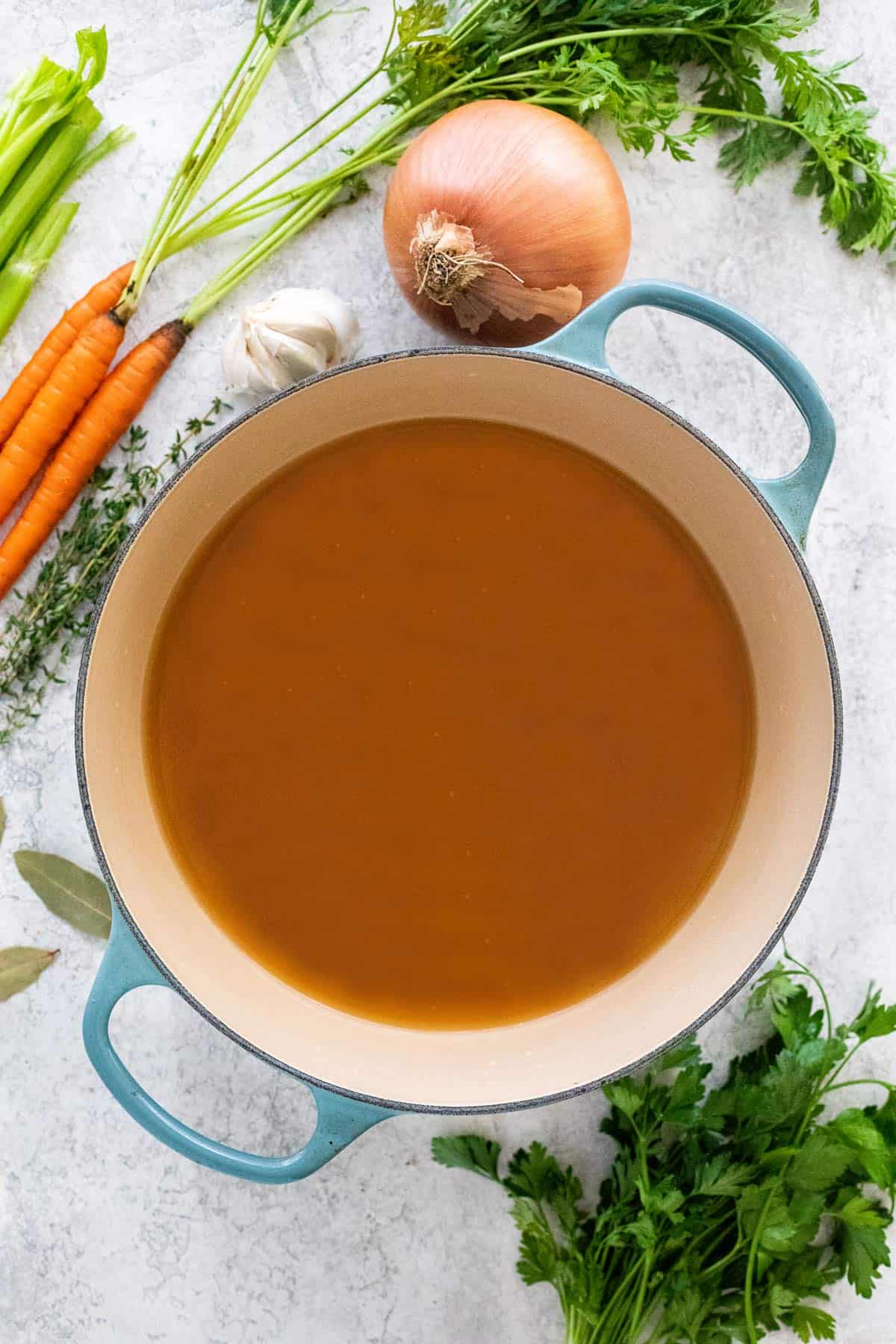
Stocks are made with bones, vegetable mirepoix, herbs, seasonings, and water. When cooking beef, turkey, or chicken bones in water for several hours, the collagen in the connective tissue and cartilage turns into rich gelatin, providing body and richness to the liquid. When cooled, you can actually see gelatin in the stock solidify. The flavor from the bone marrow also infuses into the water. The shank, neck, and shoulder have the most flavor.
In the end, it tends to be thicker and silkier than broth, and its flavor is more condensed. You can also use veal, fish, lamb, game, and ham bones. The type of bones you use will indicate the type of stock (i.e., chicken stock, turkey stock, beef stock, and so on).
What Are the Main Types of Stock?
- White Stock: Made my simmering chicken, veal, or beef bones in water with vegetables and seasonings like sachet d’épices or bouquet garni. The bones are usually quickly blanched before adding them to the stock to remove impurities, but this can be skipped for more flavor. It’s commonly used to make white sauces like velouté. I always save the bones to make homemade chicken stock.
- Brown Stock: Made with meat bones like beef, veal, or poultry, that are roasted beforehand. The caramelized roasted bones add depth of flavor and a deeper hue. Darker spices and tomato products may be added. It’s used for rich gravies and dishes like beef bourguignon. I use my homemade turkey stock to pair with turkey gravy for the holiday feasts.
- Fish Stock: Made by slowly cooking fish bones or crustacean shells without coloring them. A fish fumet can be made with the stock, adding lemon juice and wine. They are a key ingredient for seafood cioppino, bisques, and chowders.
- Court Bouillon: A quick stock made by simmering vegetables and seasonings in water and an acidic liquid such as vinegar or wine. Traditional stock may be cooked for several hours, but court bouillon may only be cooked for 30 minutes. The flavor is less intense, for use in lighter dishes. It’s used to poach fish, seafood, or vegetables. I use it to make shrimp cocktail or lobster tails.
- Vegetable Stock: Made with a combination of vegetables like onions, carrots, celery, leeks, fennel, garlic, turnips, and tomatoes. Water and seasonings are simmered with the veggie base to yield a clear and light-colored liquid. This a great vegetarian option to use in dishes like mushroom risotto, tomato soup, or roasted vegetable soup.
What is Broth?
Broth is cooked the same way as stock. However, broth can be made with just meat or meat and bones. By combining the meat, mirepoix, and seasonings in simmering water, you’ll get a clearer, delicious cooking liquid.
The consistency is thinner when cooked without bones. Unlike stock, it won’t gel as it chills because there’s no collagen. A quality broth is judged by its clarity, while a richer flavor, less clarity, and deeper color define the quality of stock.
I use my chicken broth recipe to make a lemon chicken orzo soup or chicken andouille sausage gumbo. The bonus of making the broth with meat is that you can shred the chicken to add more protein to soups and stews. I like to use it to make more meals like chicken enchiladas or chicken tortilla soup.
What is Bone Broth?
Bone broth is very similar to stock, but it’s simmered much longer—typically 12 to 48 hours compared to about 2 to 8 hours for traditional stock. That extended cooking time allows more collagen from the bones and connective tissue to convert into gelatin, giving bone broth a richer body and deeper flavor.
Bone broth is considered healthier mainly because its long simmer extracts more collagen, which converts to gelatin and provides small amounts of connective-tissue–supporting amino acids like glycine. That said, the nutritional difference compared to stock isn’t dramatic, and sodium levels can be high—so it’s nourishing, but not a cure-all.
Cooking with Stock or Broth
Stock and broth are commonly used in soups, braises, stews, gravies, and sauces. When making sauces, match the stock to the dish—for example, use white stock for white sauces rather than brown stock.
In many recipes, stock and broth can be used interchangeably. However, stock typically has a more concentrated flavor and fuller body, which can add richness to a dish. If you’re cooking something with a delicate main ingredient and want a lighter flavor that won’t overpower it, broth is often the better choice.
What are Store-bought Options?

Most grocery stores carry several types of stocks and broths in the form of ready-to-use liquids, cubes, granules, and bases. While these are convenient options, the flavor won’t compare to homemade stock or broth.
If store-bought is all you have on hand, you can add flavor by simmering it with mirepoix and bones. Some advantages to store-bought (aside from convenience) include the option to buy low-sodium, unsalted, or low-fat options.





Soren Reynolds says
Jessica, how do these differ from “Bone Broth?” Or is that just another term for stock? Also, I’ve seen “Vegetable Stock.” What differentiates that from vegetable broth?
Jessica Gavin says
Great questions! I would say that bone broth is similar to stock, but it simmers with the bone and meat for 12 to 48 hours instead of 4 to 6 hours for stock. The longer simmering time converts as much collagen into gelatin as possible for good body and flavor. Comparing the labels of a major brand for vegetable broth and stock, the ingredients were very similar. Typically a broth has a lighter consistency and more clear, good for soup like chicken noodle when you want to see the ingredients. A stock has more body, and more opaque. If you’re making a blended or hearty soup, or want more body, I would use vegetable stock. I noticed the broth had move sodium.
Sandra Fisher says
how much seasoning should be used: tsp.TBS?
Jessica Gavin says
It depends on the amount of stock or broth, and if it’s salted or unsalted. I always start with less, then increase to taste. What seasonings are you thinking of adding?